Common Concerns
There are a number of concerns that can present alongside eating disorders, many of which I kept to myself due to embarrassment and fear of what others would think if they knew what was going through my head.
Sadly, many of these thoughts and beliefs can leave you questioning yourself and force you into a state of denial where you are left toying with the thought ‘do I really need, want, or deserve help?’ In reality this is completely untrue and a vulnerable place to be.
By sharing the sensitive thoughts and feelings I experienced, I hope to show others that they are not the only ones feeling this way, but also how manipulative eating disorders are – because mine did anything it could to pull me toward it so it could get a tighter grip and maintain control.
Common feelings, thoughts, and beliefs:
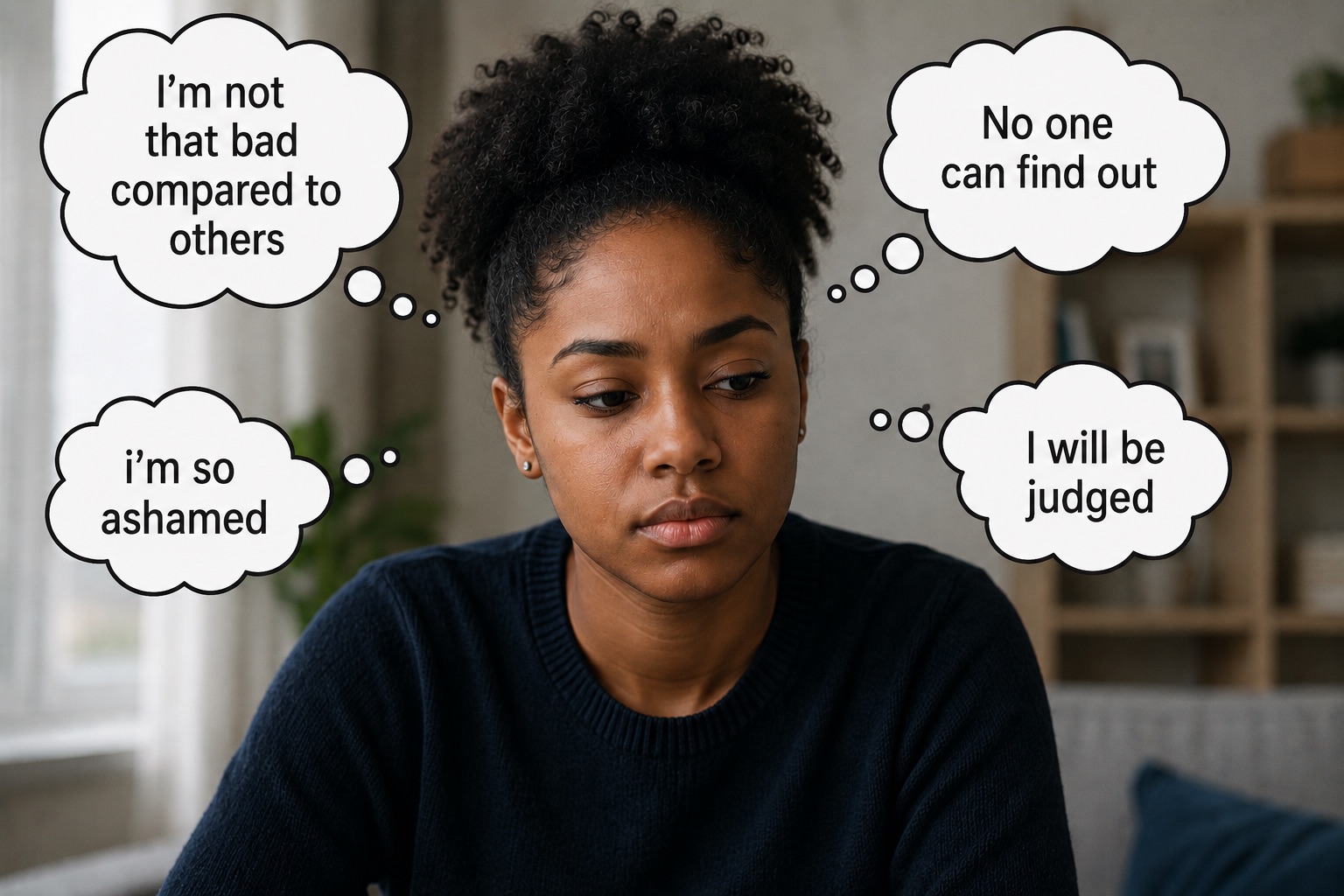
I’m not that bad compared to others.
Sadly, eating disorders have a toxic symptom that many of us experience: comparing our circumstances and physical presentation to others with eating disorders. Doing this made me trivialise my own experience, which proved detrimental to both my eating disorder and my recovery journey.
For myself, many of these feelings were driven by my misconception that anorexia nervosa was the most serious eating disorder diagnosis and that I had to be emaciated to have a valid ED. In reality, anorexia nervosa is one of the rarer eating disorders, and only a small percentage of those living with this diagnosis present at a very low weight.
The larger proportion of individuals living with an eating disorder struggle with diagnoses such as bulimia nervosa, binge eating disorder, and OSFED. These often present at a medically ‘healthy’ weight or above and are just as destructive and serious as any other eating disorder.
I was both confused and embarrassed by my instinct to compare myself to others with EDs, and this fuelled my strong desire to be more unwell. I now see this was my need to confirm that my eating disorder was valid, my need to be the ‘best’ at the illness, but also as a means of giving myself permission to reach out for help.
Comparing yourself and feeling that you are not ‘ill’ enough is, sadly, a common belief that comes hand in hand with EDs. It is pointless and destructive, and I wish I had never allowed it to fuel my symptoms and pull me further down the ED rabbit hole.
ALL eating disorders are serious and valid, regardless of stage, physical presentation, or diagnosis. Each requires professional advice and support to work towards recovery.
Please refer to the following link for more information surrounding this topic.
I will be labelled and judged
Like many others, one of my concerns around seeking help was my belief that I would be labelled and judged. I feared being seen as mentally ill and weak if I received a diagnosis because it would confirm there was something fundamentally wrong with me as a human being.
The truth is that there are millions of people in the UK and around the world living with mental health conditions, from depression to disorders such as bipolar disorder and schizophrenia. Eating disorders affect many individuals from all walks of life. They are nothing to be embarrassed about, and they do not make you weak.
I know first-hand how being told the above doesn’t always change how you feel about yourself because I applied different rules to myself than I did to others. But the reality is that I was no different at all, and accepting that fact was one of the best things I ever did.
It turns out that getting a diagnosis was one of the best things to happen to me because it meant I was referred to the most suitable service for treatment and support.
Sometimes we have to look at the bigger picture, and I can see now how delaying going to the GP or contacting professional services leaves a person suffering for longer, allowing the illness to escalate and steal more time from your life.
For me, who cares if I have a diagnosis of bulimia and anorexia on my record? People are far more understanding of these conditions than I thought, and anyone who judges or labels me is ignorant and closed-minded, and that is okay.
I personally feel sad for those who judge and label a person because of their mental health condition, and I now feel blessed to have struggled over the years because I can empathise and resonate with people, which is a gift. I am also a stronger and more resilient person as a result.
Without my eating disorder and mental health diagnoses, I would not be doing this now. Helping others and creating Munch and Mend has been one of the most rewarding and motivating things I have ever done in my life.
Please give yourself the chance and seek help as soon as possible. I am far more than any diagnosis or label, and so are you. Feel sympathy for those who cannot see that, because they are missing out, often through no fault of their own.
Seeking help could spare you years of struggling and give you years of living. Please trust me when I say it will be one of the best decisions you ever make.
What if I seek help and I am not taken seriously?
Due to the common misconception that a serious eating disorder occurs only when an individual presents as thin and emaciated, the thought of approaching a professional for help can be extremely daunting, particularly when you don’t fit this profile.
I experienced this very conundrum in my late teens, when my purging anorexia returned with a vengeance. I remember desperately wanting to go to my GP for help when my symptoms started to take over my life, but I was paranoid that I would be sent away or not taken seriously because I was a medically ‘healthy’ weight.
I feared my circumstances might be trivialised and disregarded because of my physical presentation. Sadly, because of this, I dismissed the reality of the uncontrollable, risky behaviours I was engaging in and failed to acknowledge how much of my life was being taken over by the illness.
Now I realise that it was not about being thin and emaciated, but the impact on my quality of life that made my ED valid, and that my struggles with food, weight, and shape were serious from the get-go. I always had a recognised eating disorder, even when I was at the top end of the medically ‘healthy’ weight range for my height, or above it during the periods when I struggled with binge eating.
Medical professionals should always take eating disorders seriously, whether they are symptomatic of bulimia nervosa, binge eating disorder, OSFED, anorexia nervosa, or ARFID, regardless of how a person physically presents. GPs will direct you to the resources and services that can best support you with professional help and advice.
Unfortunately, there will be some professionals out there who may say the wrong thing or make comments that leave you feeling overlooked in some way. Please know that many of us have had these types of experiences at some point in our journeys.
Sadly, this is often due to naïve ignorance and a lack of training and understanding, rather than any ill intent on the part of the professional. In reality, medical doctors receive minimal training on eating disorders during their medical education, and I suspect that much of this focuses on the physical health aspects of these conditions.
You may also be surprised by the lack of training on eating disorders within mental health services, which blows my mind considering that staff will interact with many patients struggling with food and body image concerns, as well as diagnosed eating disorders. This is yet another motivation behind this project, as well as my passion for co-delivering eating disorder training alongside my local eating disorder service.
Please do not let the fear and anxiety of not being taken seriously deter you from seeking help. If you feel disappointed after an appointment, please go back or make an appointment with a different GP. DO NOT feel that you need to go away with the determination to become more unwell to get the help you need, because that is futile and destructive. The odds are that you will never feel ‘ill’ enough because that is the nature of these conditions.
If you are struggling with food or body image concerns, I am pleading with you to take that step and reach out for help. You need support, and you do not have to face it alone. I am rooting for you because I know that recovery is out there, and it can be yours if you want it.
I feel so ashamed and embarrassed
Eating disorders can inflict a lot of shame, guilt, and embarrassment on a person, often the result of symptomatic behaviours that present with certain EDs. Some carry more shame than others, and the amount of shame associated with each behaviour can feel different from person to person.
For me, the act of self induced vomiting was one of the behaviours that carried the most shame, guilt, and feelings of self-loathing. It also forced me into a constant state of anxiety as I lived in fear of others learning my secret.
Eating disorders affect millions of people, many of which have experienced the same or similar symptoms and behaviours. Unfortunately, the stigma and shame attached to these behaviours means they are often seen as taboo, and rarely discussed.
As part of my Munch and Mend project, I have created a section where I disclose some of the most degrading and distressing eating disorder behaviours I experienced over the years. I have shared these details to challenge the shame and stigma head-on, and let others know they are not alone – as well as my hope it will act as a deterrent and raise awareness of the true toxic nature of eating disorders.
For many years, I felt I was warped because I was convinced I was the only one doing a lot of these things. As a result, I isolated myself, which allowed my ED to get a tighter hold on me, and it destroys me to think that others may be struggling in the same way.
Please know that eating disorders are an illness, where the symptoms and behaviours are out of your control. I have accepted this and come to terms with the things I did by realising that many of my behaviours were driven by my body’s physiological response to restricting my food intake, and that there is a reason for every human behaviour.
If you are feeling shame and guilt around your symptoms, please know that there is nothing shameful in having an eating disorder. ALL eating disorders are serious mental health conditions that are NOT your fault. Please seek help as soon as possible and be kind to yourself 🧡 🩵
Please see link below that will take you to my section about the degrading symptoms and behaviours I experienced:
Fear of change
In the early stages of my eating disorder, I was lured into a false sense of security, believing I was in control. The self-discipline I experienced gave me a buzz, or so I thought, and I felt I was getting positives from the disorder.
These so-called positives made it very hard to want to change and seek help because I didn’t want them to stop. Not seeking help early allows eating disorder symptoms to escalate rapidly, as the behaviours and feelings become second nature and ingrained. My eating disorder took on a life of its own and soon controlled every ounce of my being, including every decision I made.
If you are struggling with unhelpful thoughts and behaviours around food or are in the early stages of an eating disorder, I urge you to seek help immediately. You may be feeling more benefits at this stage, but the day will come when the eating disorder will turn on you, and the positives will disappear.
I was blind to the progressive nature and stages of my anorexia and bulimia, naively coasting through what I call the ‘honeymoon’ phase until the ED took control. It became a relentless, desperate existence that destroyed my self-worth and quality of life, and for what?
If you are experiencing conflicting thoughts on whether you should get help, please make an appointment with your GP or reach out to a professional service as soon as possible. Save yourself, because it is just not worth it.
Guilt – I am doing this to myself
One of the most anxiety-provoking false beliefs I had was that I was causing the ED symptoms I was experiencing, myself. This couldn’t have been further from the truth. Sadly, this self-blame escalated the shame and guilt I felt, increasing my reluctance to seek help and encouraging me to keep my eating disorder hidden.
Eating disorders are not something we choose, but an illness that drives thoughts, feelings, and behaviours that are completely out of our control. Yes, certain behaviours are carried out by us physically, but they are not carried out by active choice. Eating disorders are powerful, manipulative conditions with one primary objective: to take over your life.
My eating disorder wanted me to believe I was the culprit behind my enduring symptoms, and for a long time, it succeeded. Now, in recovery, I can see how I was manipulated into turning everything in on myself and adopting the false perception that my eating disorder was of my doing.
Please know that eating disorders are a serious mental health condition. You are not doing this to yourself; you are at the mercy of a toxic, destructive illness. Please don’t let your eating disorder impose feelings of self-blame and guilt on you for a day longer. I have learned to hate and despise my ED with a passion, and this was a game-changer in my recovery journey. It may just be for you.
Naively, turning to purging, starvation, and exercise as a method to control my size was the worst thing I ever did. I learned the hard way how potent and toxic eating disorders are, and I know how important it is to seek help in the early stages, because your symptoms can quickly escalate and take on a life of their own.
My eating disorder turned me into a person I could not recognise, challenging my strict morals and beliefs to fulfil my urges and desperation around food, weight, and shape. And I know many others that have followed a similar path.
The above concerns, although sensitive, are very commonly felt and often come hand-in-hand with eating disorders. You are NOT alone and it is not your fault. It took years for me to accept my anorexia and bulimia were such, always blaming myself. Ironically, the guilt and blame I internalised forced me to reach for my ED more.
Today, I look back and wish I had been able to let go sooner. However, I cannot change the past but I can control my future, and helping others is one of the main motivations driving this project and helping me thrive in recovery. And I wouldn’t change it for a minute.