Introduction
I was first introduced to the Minnesota Starvation Study (The biology of human starvation)1 while in active treatment at my local eating disorder service. It was a game-changer in terms of improving my understanding of the symptoms and behaviours I was experiencing alongside my battle with purging anorexia and bulimia, but it also allowed me to challenge some of the self-disgust and self-loathing caused by the more unorthodox and degrading things I was doing to meet the demands of my eating disorder, over which I had no control.
It was enlightening to learn the biological responses of the human body when it is exposed to prolonged food deprivation, and the effect this has on a person’s physical, mental, and emotional wellbeing when the body is in a state of semi-starvation. I would recommend everyone take a look, because it answers so many questions, even about minor, non-eating-disorder-related eating habits and behaviours that are experienced by those in the general population each and every day.
More importantly, I would recommend anyone living with concerns around their weight, shape, and eating, or anyone exhibiting the slightest signs of an eating disorder, read up on this subject as soon as possible. Not only will it educate you on the side effects of semi-starvation and dysfunctional eating, but it will open your eyes to the hidden, gruelling symptoms and mental torture that are the harsh cost of striving to be a weight that is beneath what your body needs to function at full capacity.
So often in the media we see shockingly thin, anorexic, emaciated images that bear no indication of the agonising sacrifice that has been made to achieve such an extreme physique. These images are often glamorised and shared to promote this lifestyle as appealing to the world, including our impressionable young population. Unfortunately, we are all exposed to a distorted perception of reality nowadays through daily use of social media, where most people show only a small part of their life — and only the part they want everyone to see.
Back in 1994 there was no internet, let alone social media, but I was still exposed to the toxic misconception of eating disorders when I watched an Australian soap opera at 5pm in the afternoon as an unhappy, overweight 12-year-old.
The storyline was about a teenage girl who turned to anorexia and bulimia to manipulate her physical appearance. Although covering this topic raised important awareness around mental health and eating disorders, the care, attention, and love that the character received as a result of her being thin and ‘ill’ had significant appeal to me. Let’s face it — I was an overweight kid who was being ridiculed and mocked every day, so the thought of having some positive attention and finally being accepted was too big an opportunity to miss.
Unfortunately, every storyline covered in a TV soap opera is short-lived and they promptly move on to the next, which left me with a very distorted perception of the reality of eating disorders, where I was confident I could use it as a temporary measure to lose the excess weight and then continue on with my life in a much healthier, happier place. If only I had known the truth.
Not only does the Minnesota Starvation Experiment explain many of the symptoms, feelings, and behaviours that occurred alongside my eating disorder, but it also helped me understand the challenging rehabilitation stage that involved regular eating and weight restoration. During this recovery process and treatment phase, the feelings of immense hunger, overwhelming anxieties, toxic thoughts, and relentless, erratic urges to engage in certain behaviours around food were very confusing, scary, and hard to explain.
For many years I had silently struggled with feelings of being warped, sick, and twisted because I was engaging in the most undignified, degrading behaviours. There was no way on earth I could tell anyone what I was doing because I was riddled with shame, guilt, and self-loathing that was tearing me to pieces.
Sadly, this loneliness, combined with the disgust and self-hatred I felt, became the ‘oxygen’ my eating disorder needed to thrive and escalate, where it metastasised and infected every part of my life.
Given the title of the experiment, I was convinced the study would be relevant only to those individuals experiencing anorexia nervosa who presented physically fragile and significantly underweight. But I was very wrong, because the results showed strong resemblance to both my anorexia nervosa and bulimia, where I had presented as both medically healthy and weight-deficient.
So, what was the study about?
In November 1944, a man named Ancel Keys ran a 12-month experiment at the University of Minnesota with the primary objective of investigating the physical and psychological effects of starvation on the human body.
The results were to be shared and used as a resource for advising Allied relief assistance on the effects of famine on victims at the end of World War II, when concerns were raised regarding the risk of mass famine among civilians during political conflicts.
The study was carried out on thirty-six perfectly healthy male Civil Public Service volunteers who each signed up to the gruelling experiment for the greater good of research, understanding, and helping those who may be suffering in the future.
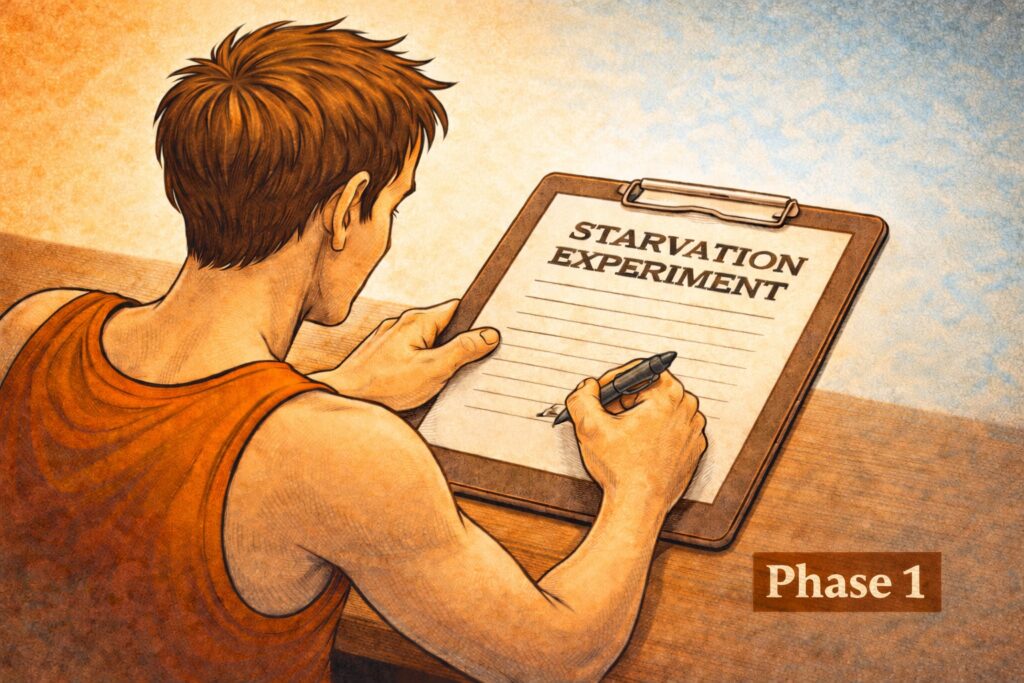
Phase 1: Pre-Starvation
Duration: 12-weeks
Volunteers ate a ‘normal’ amount of food (approx 3,200kcal/day)
Aim: observe & document each subject’s baseline including physical & mental health.
Phase 2: Semi-Starvation
Duration: 8-weeks
Subjects were forced to lose 25% of their body mass through reduced calorie intake and exercise.
They were required to walk 22 miles per week.
Phase 3: Restricted Rehabilitation 3
Duration: 12-weeks
Subjects split into 4 groups & restricted to 2000-3000Kcals/day
Diet was varied per group with added vitamin & protein supplements.
Phase 4: Unrestricted Rehabilitation
Duration: 8-weeks
The volunteers were allowed to eat as much of whatever foods they wanted
Overall Outcome
The results of the study were recognised as having a close resemblance to the behaviours and feelings experienced by individuals diagnosed with eating disorders, and played an important role in helping scientists understand how prolonged food restriction affects both the body and the mind.
Researchers found that starvation didn’t just cause weight loss, but it also led to intense food obsession, anxiety, depression, irritability, and distorted thinking about eating, which are symptoms often seen with eating disorders like anorexia nervosa.
The study also demonstrated that many psychological effects that were once thought to be personality traits, were direct consequences of malnutrition. This insight helped shift medical understanding toward treating eating disorders as serious health conditions with biological and psychological components, rather than simply issues of willpower or behaviour.
Was the study Ethical?
If the Minnesota Starvation Experiment were conducted today, it would likely be considered unethical because modern research standards place far greater emphasis on protecting participants from harm. Although the original study used volunteers, current ethical guidelines require that risks be minimised and justified by clear benefits, and deliberately subjecting people to prolonged starvation would be seen as causing significant physical and psychological harm.
Participants in the historical study experienced severe weight loss, depression, obsession with food, and lasting health effects — outcomes that modern institutional review boards would almost certainly deem unacceptable. In addition, today’s standards scrutinise whether consent is truly free of pressure, and the fact that the original subjects were conscientious objectors during wartime might raise concerns about subtle coercion. Overall, contemporary ethics prioritise participant well-being over scientific gain, making such an extreme deprivation study highly unlikely to be approved now.
Despite the study now being considered somewhat unethical, I personally feel eternally grateful that it was carried out. The commitment of the volunteers not only helped gather crucial data for its intended purpose, but has also been fundamental to our understanding of eating disorders and the physiological effects of starvation on human behaviour – knowledge that continues to change and save lives to this very day.
For me, the evidence speaks for itself, and I dread to think how I would ever have processed, accepted, or forgiven myself for all the disturbing and distressing behaviours I engaged in whilst in the grip of my eating disorder if I hadn’t learned about the Minnesota Starvation Experiment and its documented outcomes. I was convinced I was fundamentally flawed as a person and had been born ‘wrong’, but that wasn’t the case at all.
My Key Take-Aways
For me, the results of the experiment confirmed that my symptomatic behaviours, erratic thoughts, and feelings were the result of physiological responses to my body entering a state of starvation or semi-starvation, and not because I was a freak of nature — which proved to be a crucial turning point in my ED journey.
Despite the study being centred around starvation through a controlled calorie deficient diet that would forcefully cause a target weight loss of 25% from pre experiment body mass similar to the presentation of anorexia nervosa, the results were very surprising to me.
Learning the physical and mental effects of starvation, and how symptoms and behaviours mirrored other eating disorder diagnoses at the different stages of the starvation and re-feeding process, taught me that a person can be in a state of malnutrition and starvation without being emaciated.
Through this, I was able to be more accepting that weight was not always the primary driver for every behaviour and symptom I experienced, and that my restriction and avoidance of certain foods was sending my body into semi-starvation when I was a medically ‘healthy’ weight because to it was deficient of vital nutrients, minerals, and vitamins that it needed to function effectively.
Learning about The Minnesota study also played a massive part in helping me relieve some of the overwhelming guilt and self-persecution that had manifested from the disturbing behaviours and actions I was engaging in, and had engaged in, since my early teens.
I now accept that the human body is an extremely clever and adaptive vessel that requires nutrition and self-care to aid both physical and mental health. This has been key to helping me fight my eating disorder over the years, and how I have finally learned to give my body the respect and value it deserves so I get the best out of it from this moment onwards.
The Most Important thing I’ve Learned
My body is, in fact, my ‘temple’, and trying to force it to be a size and shape below what it needs to function effectively and thrive would forever leave me in the grips of a vindictive eating disorder. Allowing myself regular, varied nutrition has enabled my body to find its natural set point for the first time in its life. It may be a bit higher than I was hoping for or would prefer, but it was a trade-off I had to make — and one I will never take back. I just wish I’d done it sooner and been able to get the best out of myself in a world free from the pull of an eating disorder.
Today I am free, and I will continue to make up for those tainted years that were dictated by the debilitating rules of my eating disorder. I appreciate my life and the people in it more than anyone could possibly imagine, and for that I have my eating disorder to thank. Although the journey was hard, I have finally hit the jackpot, and I wouldn’t change it for the world.
References/Key Notes
[1] Keys, A. (1948). Caloric undernutrition and starvation, with notes on protein deficiency. Journal of the American Medical Association, 138(7), 500-511