Phase 4 — What Happened When Food Was No Longer Restricted?
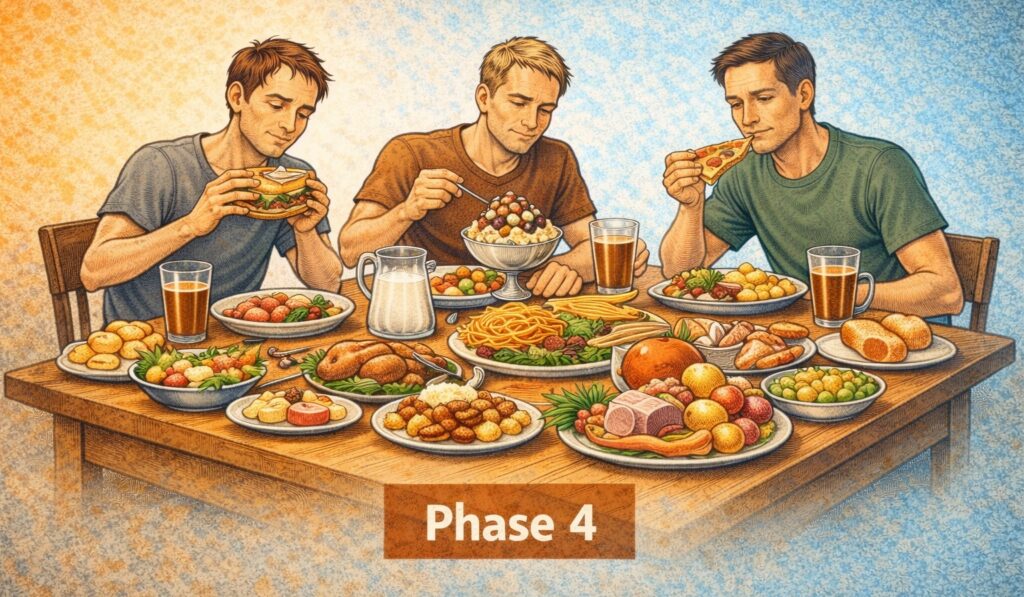
In the final stage of the Minnesota Starvation Experiment, participants were finally allowed to eat freely, without limits. After months of restriction, researchers wanted to see what would happen when their bodies were given full access to food again, and what they found was striking.
Most of the men began eating very large amounts — often thousands of calories more than expected — and many still felt intensely hungry. This wasn’t because they lacked willpower. It was their bodies responding exactly as biology is designed to after starvation. When the body has been deprived, it switches into survival mode, driving a powerful urge to eat so it can repair itself and protect against future famine.
Even though food was now available, many participants still thought about it constantly and felt anxious if they didn’t have enough. Their moods didn’t instantly improve either. Some continued to experience irritability, low mood, restlessness, and difficulty concentrating. This showed that while food is essential for recovery, the mind often takes longer than the body to stabilise.
Many of the men also gained weight quickly, and some temporarily gained more weight than they had before the experiment began. Researchers realised this was the body’s way of restoring lost tissue, rebuilding strength, and creating a safety buffer after a period of deprivation. Over time, their weight naturally settled once their bodies felt safe again.
Summary of the Five Key Takeaways
1. Extreme Hunger Emerged
Almost immediately, participants began eating very large quantities of food — far more than expected.
Many consumed 5,000–10,000 calories per day, and some reported they still did not feel satisfied.
This demonstrated a key finding:
After starvation, the body’s hunger signals can become amplified rather than normalised. This response is now understood as a biological survival mechanism, not loss of control or lack of discipline.
2. Persistent Food Obsession
Although food was now freely available, many participants
continued thinking about food constantly, they ate rapidly, struggled to feel full, and felt anxious when food was not immediately accessible.
This showed that psychological effects of starvation outlast physical restriction.
3. Ongoing Emotional and Mental Effects
Even with unrestricted eating, many subjects continued to experience the following symptoms:
* mood swings
* irritability
* anxiety
* emotional distress
* difficulty concentrating
In other words, simply eating again did not instantly restore mental stability. Recovery lagged behind nourishment.
4. Rapid Weight Gain — Including Overshoot
Most participants regained weight quickly once allowed to eat freely. Many experienced weight overshoot, meaning they temporarily gained more weight than their original pre-starvation baseline.
Researchers concluded this was the body’s way of:
* rebuilding fat reserves
* restoring organ tissue
* repairing hormonal systems
* protecting against future famine
Importantly, weight typically stabilised naturally over time once full restoration occurred.
5. Appetite Took Time to Normalise
One of the most important discoveries was that hunger did not regulate immediately. Even after weight was restored, participants often remained extremely hungry for weeks or months.
This demonstrated that:
1. Appetite recovery lags behind weight restoration
2. The body requires prolonged nourishment before it trusts food scarcity is over
The Importance of Phase 4
This stage of the study confirmed something incredibly important:
- Recovery from starvation doesn’t happen the moment someone starts eating again.
- It takes time for the body and brain to trust that nourishment is consistent and reliable.
The men’s experiences showed that strong hunger, emotional ups and downs, food fixation, and rapid weight changes are not signs of failure — they are normal biological responses to starvation and part of the healing process.
My Personal Experience of Phase 4
Unfortunately, despite having been an inpatient for many months on a consistent, structured, and carefully monitored meal plan, I continued to feel hungry much of the time. My body seemed unable to recognise or respond appropriately to the internal signals that should have told my brain I was full. No matter how much I ate, true satisfaction always felt just out of reach, as though my system had forgotten how to switch off the alarm that screamed for more fuel.
This, combined with living out of county from the eating disorder unit, meant that once discharged I went from intensive daily therapeutic support to just a single one-hour therapy session per week. Those who lived locally stepped down gradually into a day-patient programme before transitioning back into community support, allowing their bodies and minds time to adjust. But for those of us who lived further away, that transitional safety net didn’t exist. The shift was abrupt, and it was destabilising.
The sudden reduction in structure and support proved incredibly difficult — not just for me, but for other out-of-county patients as well. Returning home meant returning to real life: real stress, real triggers, real anxieties, and real pressures. Without the protective environment of the unit, eating disorder thoughts and urges resurfaced with force, and many of the behaviours I had fought so hard to quiet came flooding back. It felt less like a step forward into recovery and more like being thrown into deep water without learning how to swim.
One important distinction must be acknowledged: the men in the Minnesota Study did not have eating disorders prior to the experiment, whereas I did. Because of that, my experience involved additional behaviours and symptoms unique to eating disorders. However, despite this difference, many of the physical and psychological responses I experienced during this period mirrored what was documented in the study’s final rehabilitation phase — the stage in which participants were allowed unrestricted food after prolonged starvation.
Symptoms and behaviours I experienced during my own “phase four”:
- Severe depression and unpredictable mood fluctuations
- Self-harm urges and suicidal thoughts
- Continued weight gain that my mind could not emotionally tolerate
- Intense, relentless cravings to binge because I never felt satisfied or full
- Episodes of uncontrollable binges involving large quantities of food
- Excessive and violent purging in an attempt to rid myself of what I had eaten
- The return of anorexic thoughts, restriction, and other eating disorder behaviours
- Rapid weight loss following relapses, alongside significant mental decline
Looking back now, I understand that my body was not betraying me — it was trying to save me. After prolonged deprivation, it was biologically driven to restore what had been lost, to protect me from further starvation, and to repair the damage caused by years of malnourishment. What felt like chaos, loss of control, and personal failure was in fact my body’s survival system working exactly as it was designed to.
At the time, however, I didn’t see it that way. I believed I was broken, weak, and incapable of coping. I didn’t realise that what I was experiencing had already been documented decades earlier in scientifically observed conditions. Had I understood then what I know now, I might have shown myself more compassion instead of punishment.
The truth is, unrestricted rehabilitation after starvation — whether in a laboratory study or in eating disorder recovery — can be one of the most psychologically challenging stages of all. It is the point where biology and fear collide, where the body demands nourishment while the mind panics in response.
And yet, it is also the stage where healing truly begins.
I understand it now with absolute clarity: my body was never the enemy — my eating disorder was. What felt like chaos was actually resistance, survival, and strength fighting back from deep within me. Every surge of hunger, every demand for nourishment, every refusal to shut down was proof that my body would not surrender, no matter how hard the disorder tried to break it. I am still here because my body chose life when my mind was at war with it. And that is the truth no eating disorder can ever erase: the human body is built to survive, built to fight, and built — no matter how long it takes — to win.