Video Coming Soon
Living In Denial – My Eds Evil Tactic
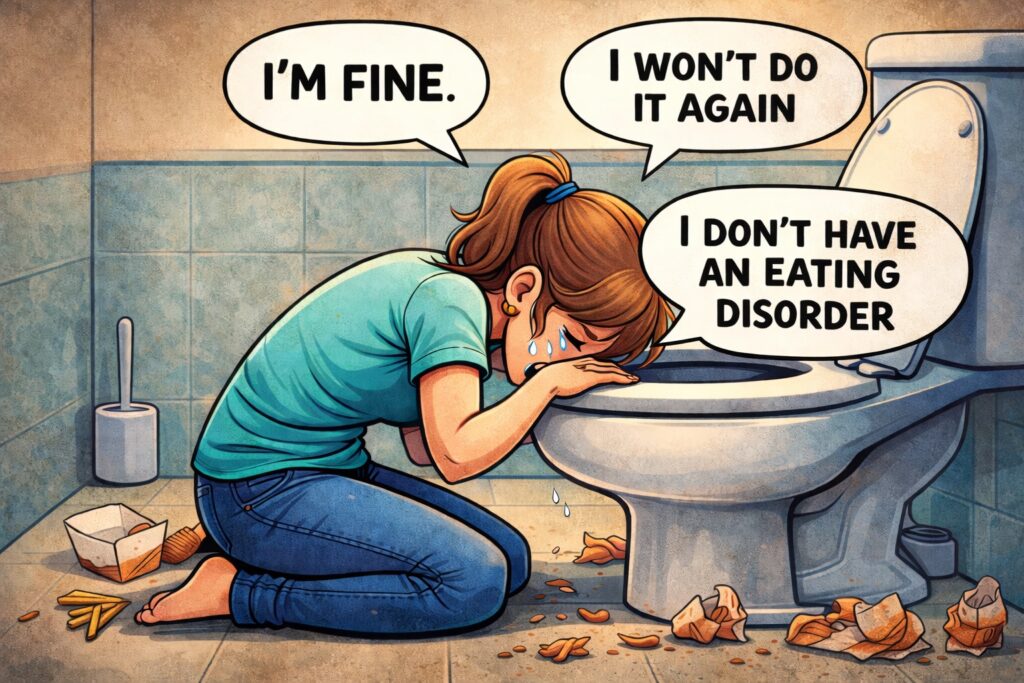
Eating disorders have a very toxic trait in that they will often force a person to believe they do not have a problem and live in a state of denial for quite some time. This unfortunately gives the eating disorder more time to sink its teeth into you and become familiar. For me, this time lapse also allowed me to get secondary benefits from my eating disorder, where my symptoms became more than a method to control my weight.
Not only did my eating disorder offer me initial positives, but the behaviours I was engaging in made me feel extreme shame and guilt, making it harder to admit I had a problem. I also perceived myself to be fine because my weight was medically ‘healthy.’ This continues to be a contributing factor for people living in denial and fuelling hesitation to seek help, but back in 1994 there was even more ignorance about any eating disorder outside of anorexia nervosa, and low weight was very much the determining factor in getting an eating disorder diagnosis.
I sometimes wonder if I had approached someone for help that very first time I made myself sick, it may not have mattered that eating disorders weren’t recognised in children at that time, because medication and support from my loved ones could have been enough to overcome the unhelpful behaviours before they became an everyday activity. I may have spared myself all those years of dedicating my life to this pointless disease.
When my purging anorexia first started, I experienced extreme changes to my physical shape and weight in a fairly short space of time. Not only was this due to my extreme eating disorder behaviours, but I was obese from years of excessive eating, and typically weight loss occurs faster when a person is carrying excess body fat.
Despite my rapid weight loss, no one appeared concerned until I started to go a bit too far the other way. My eating disorder loved this because it gave it more time and leverage to get me hooked. It also thrived on the many compliments I received in the meantime, because it allowed me to attribute these to my eating disorder and give it the credit for my improved appearance and ‘health.’
But my health wasn’t improving at all, and deep down I knew it. Once again, my eating disorder was lying to me to keep me hooked. Also, the years I had spent being told I needed to address my size because being an obese child presented a significant risk to my health made me believe the eating disorder was far better for me than continuing to binge eat and gain more weight.
In reality, anorexia and bulimia were exposing me to far more risk than I ever realised, as the unorthodox methods I was using were extremely dangerous to both my physical and mental health, and went way further than I ever thought possible.
My initial state of denial and my playing down of symptoms was short-lived, because it wasn’t very long before I realised that I was out of control, out of my depth, and was subconsciously praying that someone would realise what I was doing and come to my rescue.
Unfortunately, it took quite some time before anyone suspected I might be struggling with an eating disorder. This was most likely due to the time in which I developed purging anorexia, because at age 12 people assumed I was growing and losing the excess ‘puppy fat’ as I approached my teenage years.
This, combined with my newfound love for exercise and the fact I had seemingly lost my obsession with food and overeating between meals, left my family thinking I had finally adopted a better relationship with food. They had no idea about the tricks I was using to drive the drastic changes to my body. And by that time it had a tight grip on me.
What I Now Know
That is the cruel paradox of eating disorders: they make you unwell enough to suffer, but convince you you are not unwell enough to deserve help. They whisper that you’re fine, that you’re in control, that you don’t need support yet — all while tightening their grip and pulling you further in. They don’t want you to reach out, because seeking help threatens their existence. The disorder thrives in secrecy, denial, and silence, and it will do everything it can to keep you there.
The truth is, it was never me resisting help — it was the eating disorder fighting for survival. It needed me to believe I was fine so that it could stay. But recovery begins the moment that illusion cracks. The moment you question it, challenge it, or dare to imagine life without it, its power starts to weaken. And that is something eating disorders fear more than anything: you realising that you don’t need them at all.