Overview – Restricted Rehabilitation
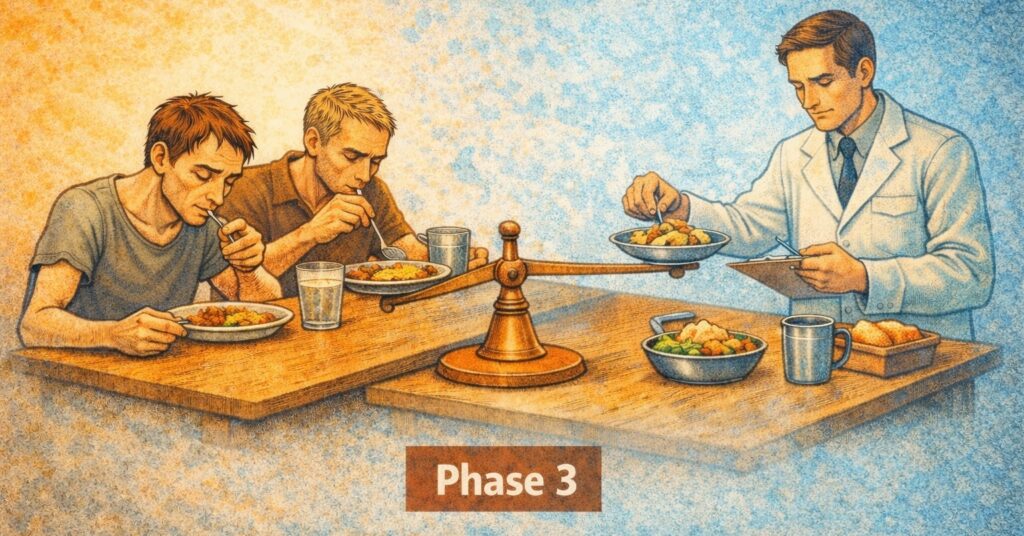
The third phase of the Minnesota Starvation Experiment was the restricted rehabilitation phase, which lasted for a period of 12 weeks. During this stage, the remaining subjects were divided into four groups. Each group was provided with similar foods, but they received different combinations of supplements and a varied — though fixed — caloric increase assigned specifically to their group.
The observations from this phase were particularly striking, as the subjects’ behaviours and mental states appeared more concerning than at any other point in the study. Despite the reintroduction of increased food intake, psychological distress remained high and, in some cases, seemed to intensify. At the same time, weight restoration was limited and slow to occur, highlighting how the body does not immediately recover once nourishment resumes. The box below outlines some of the key symptoms and behaviours recorded during this restricted rehabilitation phase, illustrating the complex and delayed nature of recovery following prolonged starvation.
Symptoms/Behaviours Observed
The Volunteers experienced the following challenges:
* Feelings/acts of self-harm
(one man chopped off three of his fingers when cutting wood. It was thought this was done intentionally)
* Intense hunger
* Persistent preoccupation with eating/food
* Loss of control around food
* Emotional instability
* Ongoing depression, anxiety
* Frustration and anger
* Restlessness and irritable
* Concentration issues and mental fog
* Impatience with recovery pace
* Feelings of desperation
* Psychological distress
* Social withdrawal
* Heightened sensitivity to stress and criticism
* Impulsive behaviours
* Strong need for larger portions/unrestricted eating
* Antagonising behaviour toward each other
My Personal Experience of Restricted Rehabilitation
My personal experience of restricted rehabilitation occurred during my treatment for purging anorexia, when I was placed on a rigid meal plan designed to induce controlled weight restoration through phased re-feeding.
In addition to the strict inflexible meal plan, my weight was closely monitored with twice weekly weigh-ins that caused me a great deal of fear and distress. I was terrified of undoing all the hard work and determination that it took to lose the weight, plus my eating disorder was screaming at me, telling me I had not gone far enough and needed to lose more.
The re-feeding process was a shock to my system initially, in both a physical and mental capacity. My body was suddenly consuming food that could be digested without the worry of it being regurgitated, which was alien to me at that time. In a mental sense, I had lost the ability to engage in the destructive ED behaviours where I could conform to the demands of the disease, which stripped me of all my go-to coping mechanisms during the most stressful and anxiety provoking time of my life.
The sudden blow from being able to feel again was one of the most distressing things from entering treatment, because I was faced with overwhelming emotions and thoughts that I had pushed down and learned to manage via the unhealthy behaviours and symptoms of my eating disorder, over many years. The feelings were unbearable, and these combined with the erratic hunger and other urges made it hard to navigate and regulate myself in every part of my life.
During the re-feeding phase of my treatment I exhibited extreme symptoms and behaviours that very much mirrored those observed in the subjects of the Minnesota study during the third phase – restricted rehabilitation.
Similarities in Symptoms/Behaviours
During my own period of restricted rehabilitation in treatment for anorexia nervosa and bulimia, I experienced psychological and behavioural changes that closely mirrored those documented in Phase 3 of the Minnesota Starvation Experiment, when participants began nutritional rehabilitation but had not yet fully recovered from the effects of prolonged deprivation. Much like the men in the study, whose emotional states became increasingly unstable during re-feeding, my mood fluctuated dramatically between brief, almost euphoric highs and sudden descents into heavy depressive lows. The instability was intense and disorienting, and I often felt as though I had no control over where my mind would land from one moment to the next.
At the same time, intrusive thoughts about food intensified rather than eased. I experienced constant preoccupation with eating and overwhelming cravings to binge and purge that felt even stronger than anything I had endured during active starvation. My behaviour became erratic, and I struggled to focus on anything for more than a few moments. Restlessness took over my body; I fidgeted constantly and found it almost impossible to relax, while irritability and frustration toward others surfaced quickly and intensely, echoing the heightened emotional reactivity described in the Minnesota subjects during rehabilitation.
The drive for food sometimes felt urgent and compulsive rather than hunger-driven. I found myself eating whatever I could access to get what felt like a “fix,” even consuming sugar from communal drink stations. I also engaged in secretive and impulsive behaviours around food and supplements, including stealing nutritional drinks and discarding evidence to hide what I had done. These actions felt both irrational and uncontrollable at the time, yet they closely resemble accounts from the study showing that refeeding after starvation can temporarily intensify obsessive food behaviours rather than immediately resolving them.
Looking back, the resemblance is striking. The Minnesota experiment demonstrated that the rehabilitation phase is not an instant return to normality but a psychologically complex period in which the mind is still recovering from starvation’s effects. My experience reflected that same reality: even as nourishment was reintroduced, the psychological aftermath of deprivation remained powerful. It reinforced for me that recovery is not simply about eating again — it is a gradual biological and psychological process in which the brain, just like the body, needs time, consistency, and care to heal.
Restricted rehabilitation was a very challenging and distressing experience, but realising a lot of my behaviours were a physiological response to reversing semi-starvation, allowed me to understand my actions and thought processes which really helped in my prolonged fight against, and recovery from both anorexia and bulimia.